Author: Toufik Dallal
Why this matters now
Many early-stage founders hear this sentence after a good pitch: “We like it, but it’s too early.”
It sounds polite.
It sounds vague.
And it often feels like a soft no.
But in most cases, it’s neither.
This phrase usually means interest without readiness. The investor sees potential. They just don’t see enough risk reduced yet. Understanding what sits behind this feedback can save founders months of frustration — and help them come back stronger.
The common founder assumption
When founders hear “too early”, they often assume:
“They want more traction”
“They only invest later”
“We need to be bigger”
“They didn’t really get it”
Sometimes that’s true. But more often, “too early” is not about size. It’s about unanswered questions.
Investors don’t look for perfection. They look for risk. And at early stage, risk shows up in very specific ways.
What investors are really saying
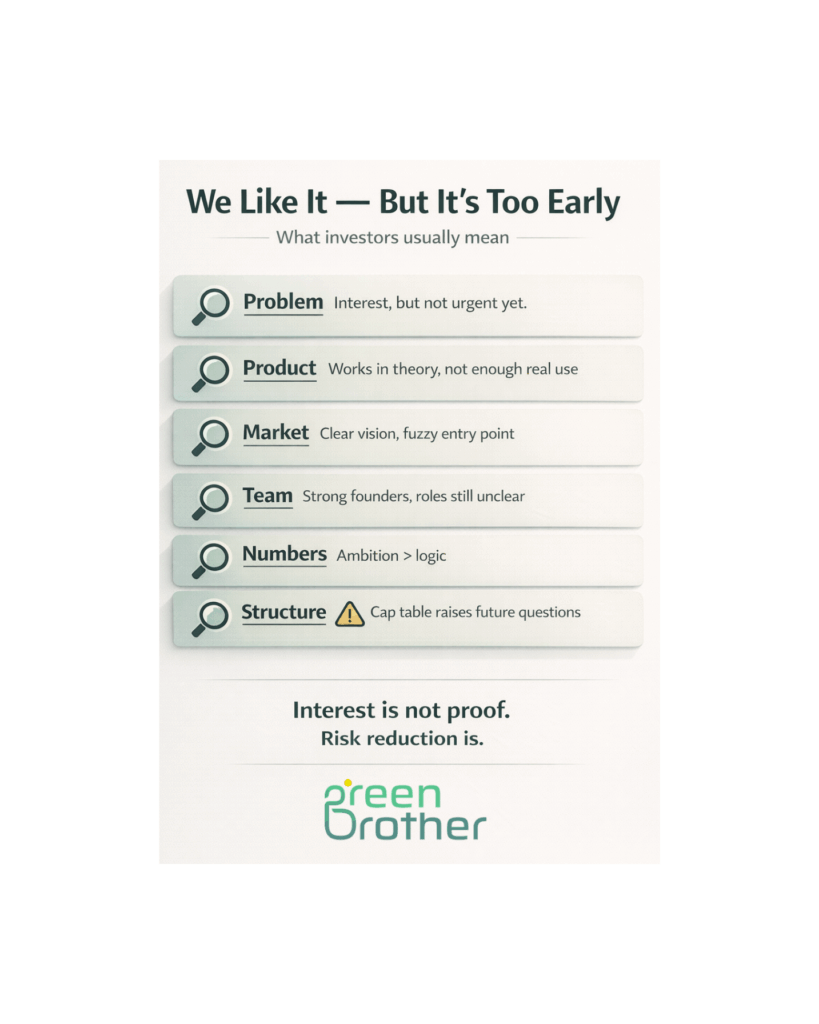
When an investor says “too early”, they usually mean one (or more) of these things: “I don’t yet have enough evidence to defend this decision to myself or my partners.” Below are the most common signals behind that sentence.
1. The problem feels real — but not urgent yet
🔍 What investors review
How painful the problem is
Whether customers actively seek solutions
If the pain triggers budget, time, or switching behavior
⚠️ Early-stage risk
Strong interest, weak urgency
“Nice to have” disguised as “must have”
Positive feedback without consequences
Many founders confuse interest with demand.
Interest is people saying:
“That’s interesting.”
Demand is people saying:
“We need this now.”
Interest is not proof.
✔ What “good enough” looks like early
Users pushing to pilot
Clear workflow dependency
Willingness to change behavior
Even small payments or strong LOIs
You don’t need scale. You need pressure.
2. The solution works — but only in theory
🔍 What investors review
Evidence the product works outside a demo
Feedback from real usage
What breaks under real conditions
⚠️ Early-stage risk
Too much vision, not enough reality
Product tested only by the team
No uncomfortable feedback yet
Investors worry when everything sounds smooth. Real usage is messy. And that’s exactly what they want to see.
✔ What “good enough” looks like early
A scrappy MVP in use
Clear learnings from failures
Honest limits of the current product
Early-stage doesn’t mean unprepared.
3. The market story is promising — but still fuzzy
🔍 What investors review
Who exactly buys
Why now
Why this market, not another
How big this specific entry point is
⚠️ Early-stage risk
Market slides that feel generic
TAM without a clear first wedge
Too many use cases at once
Investors don’t fund markets. They fund entries into markets.
✔ What “good enough” looks like early
One clear customer profile
One clear use case
One clear reason why timing matters now
Clarity beats ambition at this stage.
4. The founders are strong — but still untested together
🔍 What investors review
Role clarity
Decision ownership
How conflict is handled
Commitment level
⚠️ Early-stage risk
Overlapping responsibilities
Missing key roles “for later”
Founders who haven’t worked under pressure together
Investors back teams, not slides.
✔ What “good enough” looks like early
Clear division of roles
Honest gaps acknowledged
Evidence of working through real stress
Governance is not bureaucracy. It’s leverage.
5. The numbers exist — but the logic doesn’t yet
🔍 What investors review
Assumptions behind revenue
Sales cycles
Cost drivers
Unit economics directionally
⚠️ Early-stage risk
Forecasts that assume everything goes right
Growth without effort
Pricing without proof
At early stage, numbers are guesses. But the thinking behind them must be solid.
✔ What “good enough” looks like early
Simple model
Clear assumptions
Willingness to say “we don’t know yet”
Confidence grows from realism.
6. The round structure raises future questions
🔍 What investors review
Cap table cleanliness
Founder ownership and incentives
Ability to raise the next round
⚠️ Early-stage risk
Too many small early investors
No vesting
Heavy dilution too soon
A messy foundation slows everything later.
✔ What “good enough” looks like early
Clear ownership
Room for future investors
Aligned founder incentives
Prepared founders move faster.
What “too early” usually means — in one sentence
“I’m interested, but I can’t underwrite the risk yet.” That’s not rejection. That’s a signal.
A simple founder checklist
Before your next round, ask yourself:
🔍 Can we show real user pressure, not just interest?
🔍 Is the product tested in the real world?
🔍 Is our market entry crystal clear?
🔍 Are founder roles and incentives obvious?
🔍 Do our numbers reflect reality, not hope?
🔍 Would a new investor understand our cap table in 5 minutes?
⚠️ If two or more answers feel weak, the feedback makes sense.
Fixing this early is a strength — not a failure.
Calm closing takeaway
“We like it, but it’s too early” is not a dead end. It’s a mirror. It shows where belief exists — and where trust still needs work.
Fundraising doesn’t fail in the pitch. It fails after it. Fix this early — fundraising gets easier.
Important notice: This is educational content, not legal or financial advice.Coming next:
In our next blog post, we’ll cover how founders can come back after hearing “too early”.
What to fix first, what to ignore, and how to re-engage investors without starting from zero.
Stay tuned!