
Author: Toufik Dallal
Why this matters now
Across Europe and CEE, many early-stage founders proudly say: “We have three pilots running.” They expect this to signal strong traction and market validation. But the uncomfortable truth: pilots are not the same as traction. From some points of view, they are experiments—controlled tests designed to explore potential, not prove scalability or long-term adoption.
When investors move from excitement to analysis, their questions shift. It is no longer just “Is this development interesting for the market?” now it is “Is this solution repeatable, scalable, and capable of sustaining growth?” That is exactly where many pilot-driven stories begin to show cracks. One solution may work in one or two controlled settings, but that doesn’t guarantee it will succeed across various customers, or operational conditions.
Let’s take a closer look at why this gap emerges and how it can be addressed.
The Common Founder Assumption
Many founders believe:
- A signed pilot proves demand.
- A corporate logo equals validation.
- Positive feedback equals product market fit.
- More pilots equal momentum.
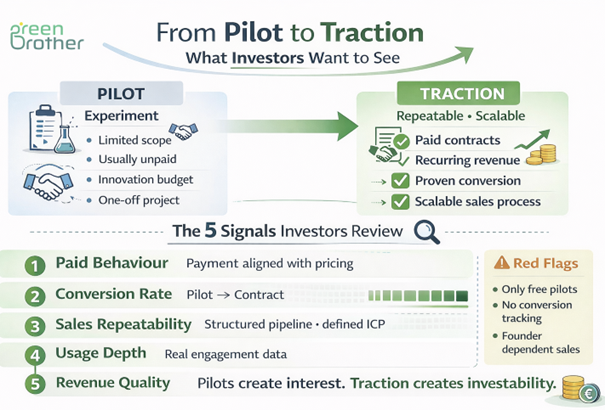
On the surface, these seem logical. But investors see pilots differently. To them, a pilot is a test environment. Practically, a pilot has the status, that it can be non-binding, not repeatable, and investors consider that.
What Investors Actually Review 🔍
When investors hear “we have pilots,” they look deeper. And they want to understand some crucial points:
1. Is this a paid pilot?
The core considerations are:
- Is the pilot paid?
- Is the pricing aligned with the long-term paying model?
Free pilots can reduce the quality of the innovation and the development processes. A small but real payment is stronger than piloting for free.
2. Is the “sales” repeatable?
Investors are also curious about these questions:
- How did you get the pilot?
- Founders’ network only or structured outreach?
- Was it a systematic pipeline?
If pilots happen only through personal relationships, investors tend to perceive a higher level of risk regarding future growth. From an investor’s perspective, the key question is scalability. Investors therefore examine whether a pilot can be converted into a broader deployment and whether different pilot stages can build on one another. When a pilot demonstrates this kind of progression, it provides evidence that the solution is scalable, and potentially relevant for the market. If such scalability cannot be demonstrated, investors generally assume a higher level of risk.
3. Is there a real usage?
A signed pilot agreement alone, without concrete usage data, provides limited evidence of market potential. To properly evaluate the potential adoption of an innovation, measurable data from the pilot phase is essential:
- How often is the product used?
- Number of active users.
- What problem frequency does it solve?
These data help demonstrate the real demand for the solution and can provide credible evidence of its practical value and scalability.
4. Is there a Budget?
Understanding where the funding for a pilot comes from is an important indicator of how seriously the organization handles the project. The source of the budget often reveals whether the pilot is treated as a strategic priority, an operational necessity, or merely an experiment. It can also signal the level of internal commitment and the likelihood that the pilot will progress beyond the testing phase.
Key questions include:
- Is the pilot paid from the innovation budget?
- Or from the operational budget?
- Or does it rely on experimental or exploratory funds?
In a structured and consistent innovation process, pilots are ideally supported by the innovation budget. However, funding from the operational budget can also be a considerable signal, as it may indicate that the solution addresses a real need and the pilot can mean necessity.
Early-Stage Risks that Quietly Block Investment Rounds ⚠️
These issues stop investment rounds more often than founders expect:
- Too many unpaid pilots
- No structured conversion metrics
- Long sales cycles hidden behind “great feedback”
- Over reliance on one single partner
What “Good Enough” Looks Like at Early Stage
You do not need 100 customers and you do not need perfect retention curves. But you should generate proven results, conversions and credible signals during the pilots. These can be excellent pieces of evidence:
- 1–3 paying pilot customers
- Defined ICP, even if still narrow
- Clear conversion path defined
- At least one converted pilot into recurring revenue
- Basic understanding of sales cycle length
Even small numbers work, if they are consistent and based on clear, proven data.
A Simple Pilot-to-Traction Checklist
Check this list, before you start fundraising:
🔍 Signal Strength
- Will be some of the pilots paid?
- Is pricing aligned with the future model?
🔍 Conversion Evidence
- Can you achieve pilot-to-contract conversion?
- Can you explain why customers convert or not? Why do some users decide to adopt or buy your product?
🔍 Repeatability
- Is the pilot repeatable?
- Is the pilot aligned with your planned sales process?
🔍 Usage Depth
- Do you generate engagement and usage frequency?
- Can you produce definite usage data?
🔍 Revenue Quality
- Will the revenue be recurring?
- What is the budgeting background of the pilot?
If two or more of these areas are unclear, strengthen them before meeting investors. Prepared founders move faster.
Founder Reality vs Investor Expectation
We have mentioned “gap” in the opening thoughts.
Founders see pilots as validation of their idea, proving that the product works. Investors, on the other hand, see pilots as validation of the business model, proving that the product is relevant for the market, can generate revenue and scalable. These are not the same: a product can work technically, but the sales and adoption engine may not. A pilot can succeed in execution but fail commercially. Investors are looking to fund scalable solutions, not isolated experiments.
B2B and Climate Sectors
In climate, mobility, deep tech, and regulated industries, pilots are normal. Long validation cycles are expected and investors understand this. But they still ask:
- Is this leading to structured revenue?
- Is the pipeline predictable?
- Is there evidence of willingness to pay?
A great technology without commercial line increases risk and investors focus on risk.
Final Thought
Do not forget, that pilots are a start, but they do not automatically show market need and demand. That is why you should shift your mindset:
Instead of saying: “We have five pilots.”
You should highlight: “We have three paid pilots, one converted to annual contract, average sales cycle 4 months, two more in procurement.” These approach can move forward to unlock capital.
In our next blog post, we’ll cover how VCs and Investors rank you signals.
Stay tuned!
Important notice: This is educational content, not legal or financial advice.