

Turning investor interest into a real second conversation
Why this matters now
Hearing “we like it, but it’s too early” is not the end of a fundraising process. For many founders, it’s the middle finger — even if it doesn’t feel like it. What happens next determines everything. Some founders disappear, keep building in isolation, and try again months later with the same gaps. Others use this moment strategically — and turn early interest into a real round. This article is about the second group.
A quick bridge from the last article
In our previous post, “What Investors Mean by ‘We Like It, But It’s Too Early’”, we explained that this phrase rarely means rejection. It usually means: “We see potential, but we can’t underwrite the risk yet.”
So the real question becomes: How do you reduce the right risks — and show it clearly?
The common founder mistake after “too early” – Most founders do one of these things:
- Build more features
- Talk to more investors
- Wait for “more traction” without a plan
⚠️ The problem: None of these automatically reduce the risks investors flagged.
Time alone doesn’t make a startup investable. Progress does.
Step 1: Decode which “too early” this was
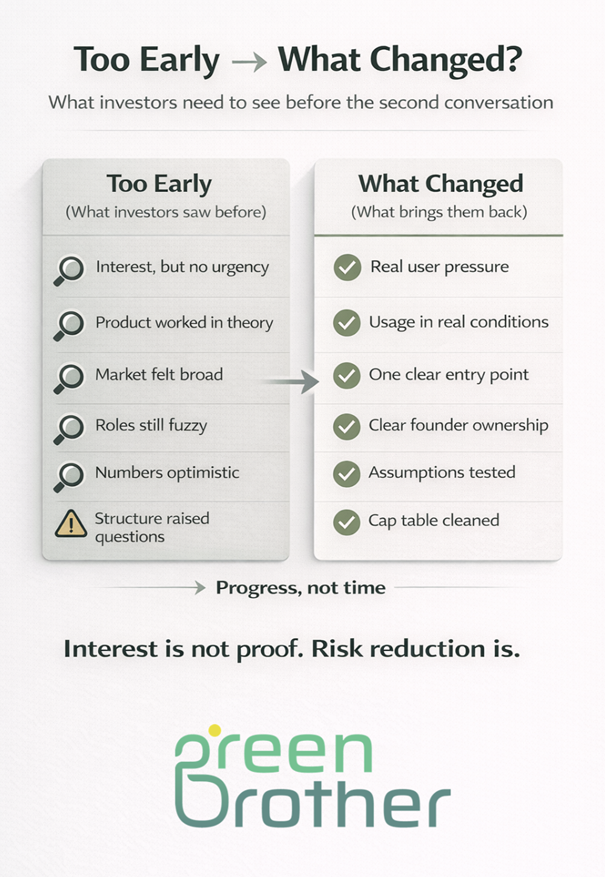
🔍 What investors usually mean “Too early” is not one thing. It’s a bundle of signals.
Before doing anything else, ask yourself: Was the concern about problem urgency? Product usage? Market focus? Team structure? Numbers and logic? Cap table or structure? If you’re unsure — that’s your first task.
✔ Good founder move
Send a short follow-up message: “To improve, what would you need to see change in the next 3–6 months?”
This is not pushing. This is professionalism. Prepared founders move faster.
Step 2: Pick one or two risks to fix — not all of them
Early-stage founders often try to fix everything at once. Investors don’t expect that.
🔍 What investors review
- Directional progress
- Focus
- Ability to prioritise risk
⚠️ Quiet blocker
Six improvements that are half-done are weaker than one risk clearly reduced.
✔ What “good enough” looks like
Choose:
- One primary risk
- One secondary risk
Everything else waits.
Step 3: Turn progress into evidence, not slides
Investors don’t change their mind because of better storytelling. They change it because of new information.
🔍 What investors look for
- Behaviour change from users
- Clear decisions made by founders
- Fewer unknowns than last time
⚠️ Common mistake
Coming back with:
- Updated deck
- Bigger vision
- Louder confidence
Without new evidence.
✔ What works better
Examples:
- 5 users now depend on the product weekly
- Pricing tested, even if imperfect
- One customer segment clearly dropped
- Cap table cleaned
- Founder roles formalised
Step 4: Control the timing of the return
Don’t wait “until it’s perfect.” Don’t come back after two weeks either.
🔍 What investors expect
- Visible movement
- Not instant results
✔ Rule of thumb
Come back when:
- At least one key risk looks meaningfully different
- You can explain what you learned, not just what improved
Learning is progress.
Step 5: Re-engage with context, not hope
When you reconnect, don’t say: “We’re ready now.”
Say: “Since we last spoke, we focused on X. Here’s what changed.”
🔍 What investors review
- Whether feedback was understood
- Whether time was used well
- Whether founders execute deliberately
⚠️ What quietly kills interest
Pretending the “too early” never happened.
✔ What builds confidence
Acknowledging it — and showing work. Governance is not bureaucracy. It’s leverage.
A simple “come back stronger” checklist
Before re-engaging an investor, ask:
🔍 Can I clearly name the risk they saw?
🔍 Did we reduce it — or just move around it?
🔍 Can I show evidence, not intention?
🔍 Is the story now simpler than before?
🔍 Would I invest based on this change?
If yes — it’s time. If not — keep building, but with focus.
Calm closing takeaway
“We like it, but it’s too early” is not a wall. It’s a map.
Founders who treat it as feedback, not judgement, move faster and raise with less friction later. Fundraising doesn’t fail in the pitch. It fails after it. Fix this early — fundraising gets easier.
Coming next:
In our next blog post, we’ll cover why Pilots ≠ Traction and what investors want to see instead.
Stay tuned!
Important notice: This article was written based on Green Brother’s accelerator and investment experience. This is an educational content, not legal or financial advice.


