Author: Toufik Dallal
The Early-Stage Due Diligence Risks Founders Underestimate
Many early-stage founders believe fundraising is mainly about the pitch. In reality, the pitch only opens the conversation.
What decides the outcome is due diligence. This is the phase where investors slow down, review details, and look for risks that could create problems later. The excitement fades, and trust becomes the focus.
Here is a truth many first-time founders learn too late:
Most funding rounds don’t fail because the idea is weak. They fail because basic risks were not addressed early.
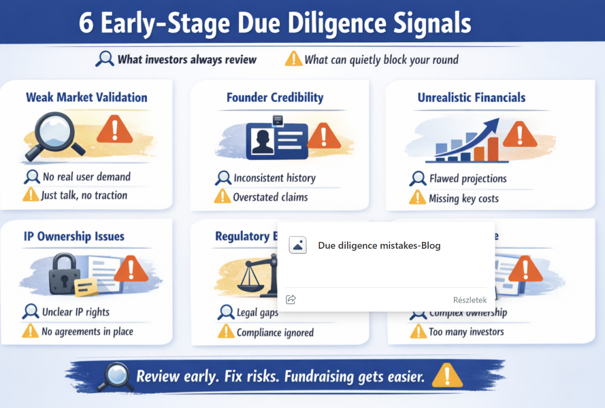
Below are the six areas investors always review and the common early-stage risks that can quietly stop a round.
1. Market Validation
🔍 What investors review
- Is the problem real and painful?
- Are users actively looking for a solution?
- Has the product been tested in real situations?
⚠️ Common early-stage risks
- Confusing interest with demand
- Relying only on conversations and feedback
- Assuming validation will come later
✔ What helps early
Pilot users, real usage feedback, small payments, signed intentions, or clear proof of urgency. You don’t need scale yet. You need proof you are solving something real.
2. Founder Background
🔍 What investors review
- Consistency of your story across documents
- Fit between your experience and what you are building
- References and reputation
- How you handle questions and uncertainty
⚠️ Common early-stage risks
- Overstated achievements
- Unclear roles or timelines
- Weak or missing references
- Defensive reactions
You don’t need a perfect background. You need clarity, honesty, and self-awareness.
3. Financial Logic
🔍 What investors review
- Assumptions behind your numbers
- Unit economics
- Sales cycles and pricing logic
- Costs that grow with the business
⚠️ Common early-stage risks
- Growth that assumes everything goes right
- Ignoring churn or sales effort
- Margins that don’t match reality
Ambition is good. Unrealistic numbers reduce trust.
4. Intellectual Property
🔍 What investors review
- Who owns the product, code, or technology
- Whether all contributors assigned rights
- Whether former employers or partners could claim ownership
- Whether the brand name is protected
⚠️ Common early-stage risks
- Missing IP assignment agreements
- Contractors without clear contracts
- Unclear ownership from earlier work
- No trademark protection
You don’t need a complex IP strategy. You do need clean ownership.
5. Regulation and Compliance
🔍 What investors review
- Ability to sell and operate legally
- Basic data protection awareness
- Understanding of sector-specific rules
- Awareness of licensing or certification needs
⚠️ Common early-stage risks
- “We’ll fix it later” thinking
- Assuming rules are the same everywhere
- Underestimating time and cost
If legal scaling is unclear, investors hesitate.
6. Cap Table Structure
🔍 What investors review
- Ownership clarity
- Founder incentives and vesting
- Ability to raise future rounds smoothly
⚠️ Common early-stage risks
- Too many early investors
- No founder vesting
- Founders already heavily diluted
- Too many advisory shares
- No plan for an ESOP
A clean cap table builds confidence. A messy one creates friction.
A Simple Early-Stage Readiness Check
Before fundraising, ask yourself:
🔍 Market – Do real users care enough to test or pay?
🔍 Founder – Is my story clear, honest, and consistent?
🔍 Financials – Do my numbers make logical sense?
🔍 IP – Do we clearly own what we built?
🔍 Regulation – Can this scale legally?
🔍 Cap Table – Would a new investor understand it quickly?
⚠️ If one answer feels weak, that’s normal. Fixing it early is a sign of strength.
Final Thought
Due diligence is not designed to stop founders. It exists to reduce avoidable risk. The founders who pass it smoothly are not perfect —they are prepared, transparent and realistic. Treat due diligence as part of building your company, not as a hurdle, and fundraising becomes calmer, clearer and far more effective.
In our next blog post, we”ll talk about what investors mean by “We like it, but it’s too early.”
Stay tuned!
Important notice: This is an educational content, not legal or financial advice.