
Interview with Dávid Varga, CEO & Co-Founder, realCity ITS Kft.
Founded in 2016 as a spin-off from earlier transport IT projects, real City has targeted the clear needs for making fragmented transport data usable in real-time. What began as the solution for the traffic management of Budapest (Capital of Hungary), rapidly developed further into the Budapest journey planner (BudapestGO). Over the years, their developments have been deployed in more Hungarian cities, like the one in Szombathely, demonstrating how modular solutions can address very different mobility challenges.
Today, realCity’s portfolio spans real-time traffic management, passenger information systems, apps for the citizens, and data analytics tools, all designed to work seamlessly together. With international collaborations such as the EIT Urban Mobility IMPULSE+ project, realCity has further expanded into electric bus operations and has entered into the international markets with it. Today, the company continues to build on its original vision: making transport systems more transparent, data-driven, and efficient for both operators and passengers.
When was realCity founded, and what was the specific transport problem, or market need that led you to establish the company?
realCity was founded in 2016 as a spin-off from earlier transport IT projects, building on our work with the Centre for Budapest Transport (BKK) since the early 2010s. Our first developments were custom solutions, including traffic light priority for public transport and the FUTÁR journey planning and passenger information applications. These projects highlighted a recurring issue: while transport systems generated a significant amount of data, it was often fragmented and not effectively used for real-time operations or passenger communication.
At the same time, we recognized that many of these one-off developments could be turned into reusable solutions with relatively limited additional effort. This led to a clear business direction: to “productize” what we had built for BKK and make it adaptable to other cities with minimal customization. Since then, our focus has remained on making transport data more accessible and actionable for both operators and passengers.
Seeing your website, your company provides transport IT solutions to multiple target groups. Your portfolio ranges from traffic management systems, through community information systems to apps for the end users. What services do you offer, who are your clients, and how does this diversity come together as a unified service portfolio?
We contract mainly with municipalities, public transport authorities (PTAs), and operators (PTOs), while the daily users of our systems include dispatchers, customer service staff, timetable planners, drivers, and passengers. Our solutions are designed to support both operational processes and passenger information within the same framework.
In terms of products, our portfolio can be grouped into a few main areas. We provide real-time traffic management and vehicle tracking systems, including dispatcher (operational oversight) and on-board unit (driver support and tracking) software. Additionally, we’ve developed passenger information systems (e.g. journey planner apps and routing engine with real-time data processing). We also offer tools for solutions for data management, integration, and standardized data with replay and analytic capabilities.
These components can be implemented and used separately, but they are designed to work together. Because they rely on a shared data structure, we can integrate them with existing systems and gradually extend their functionality. This allows clients to improve different parts of their operation while building towards a more consistent and data-driven system.
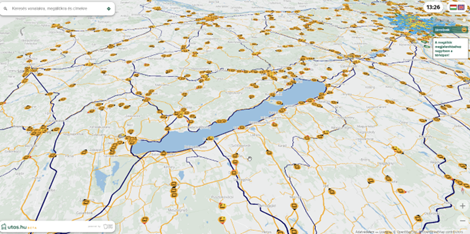
(UTAS.HU system)
Could you share with us some success stories? Who turned to you with what kind of mobility challenges, and as a solution what kind of services did you develop?
A good example is our long-term cooperation with BKK in Budapest. Around 2014, as part of the FUTÁR system, the journey planning applications were not included in the original traffic management scope, so they had to be developed as a separate component. This is where we contributed, building the journey planning and passenger information applications and integrating them with the existing backend systems. The main innovation was not only the application itself, but the way it connected real-time operational data with passenger-facing services: the BKK FUTÁR apps were the first to display real-time vehicle positions for passengers in Hungary, even before this feature became available in Google Maps. In 2022, the apps were redesigned into BudapestGO, but the FUTÁR apps still receive updates and remain popular among users. Today, our journey planner apps are available all across Hungary, which is a good example of how a custom development can evolve into a product.
A different type of challenge came from the city of Szombathely, where a new operator, Blaguss, had only a few months to launch operations. In this case, our standard, out-of-the-box solution alone was not enough, we had to integrate our entire system (traffic management, on-board units, passenger information) with a new ticketing system and on-board passenger information hardware within a very limited timeframe, while ensuring stable operation from day one. Our clients, cities, PTAs, and operators often work with long procurement cycles and complex administration, meaning that by the time a project starts, the pressure for fast results is already high. This is why flexibility and short delivery cycles are critical. We combine productized solutions, which allow for fast deployment and a good price–value ratio, with the ability to adapt and extend them when needed.
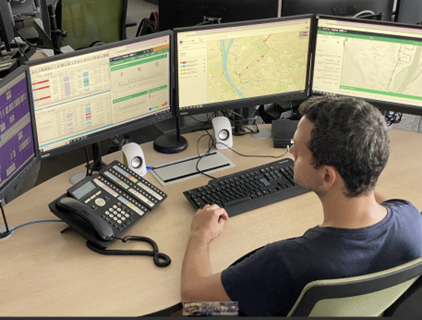
(Budapest, „the brain” of the FUTÁR)
Regarding the long-term cooperation with the Centre for Budapest Transport (BKK) since 2012, can it be a good example for the evolutionary “stages” of a service portfolio development, as a response to the growing needs towards mobility services?
Yes, our cooperation with BKK is a good example, but perhaps less in terms of a predefined roadmap and more in how we respond to emerging needs. In the early years, almost every product we have today was triggered by a specific request from BKK. This required a high level of flexibility and fast reaction, which helped us become a trusted problem-solving partner over time. An important aspect from the beginning was how we kept intellectual property and gave only usage rights allowing us to further develop and reuse solutions in other contexts, rather than creating one-off developments. This approach also benefits our contracting partners, as they continuously receive updates, fixes and new features, making it more cost-efficient than keeping development in-house.
Our first entry point in 2013 was traffic light priority for public transport, establishing the relationship. The next step was journey planning, which significantly deepened the cooperation. While we continue to develop custom features for BKK, many of these are also incorporated into our product and later reused in other cities. A good example is the “plan from vehicle” feature, which was first introduced in BudapestGO and is now available in other cities using our applications.
In 2016, based on the availability of detailed operational data, we developed a data replay and analysis interface. We approached BKK with the idea, recognizing that the growing amount of data could be used not only for timetable planning but also for quality assurance and operational insights. This later became a standalone product and also served as a foundation for our work in EU co-funded electric bus projects.
Another example is our on-board unit software. BKK wanted to include heritage “nostalgia” vehicles in traffic management without modifying the vehicles themselves, which led us to develop a mobile -based solution. These units have since been applied in several other cities to support full fleets.
Finally, the experience we gained in handling many data sources at BKK allowed us to build a broader data management capability. Today, we process dozens of data sources from various systems, including real-time data from thousands of vehicles across the country and provide it to external platforms such as Google Maps, in line with their strict data requirements.
Over time, these smaller components have been combined into a more complete platform. We have developed our own core elements, including dispatch and incident management tools, and today we are able to support the traffic management and passenger information needs of even larger cities with 100+ vehicles as a single supplier, continuously working on new features and modules.
END OF THE 1st PART OF THE INTERVIEW. CONTINUED…