Author: Toufik Dallal
Why it matters now?
Fundraising creates a strange contradiction. You need capital to accelerate the business. But to convince investors to provide that capital, they want evidence that the business is already moving.
So while you are building the pitch deck, taking investor calls, answering diligence questions, and updating your financial model, someone still needs to acquire customers, improve the product, manage the team, and hit the next milestone. That someone is usually you. This is where many early-stage founders make a costly mistake. They treat fundraising as a temporary pause from building the company. For two or three months, investor meetings become the main activity, while customer conversations, sales, product work, and execution slowly move into the background.
From the founder’s perspective, this can feel logical. Closing the round is urgent. From the investor’s perspective, however, a company that stops progressing while fundraising can become less attractive with every passing week. A strong fundraise should happen alongside a business that is getting harder to ignore.
The common founder assumption
The assumption usually sounds something like this: “Once we close the round, we can really start growing.”
The problem is that investors are rarely underwriting the company you promise to build after the money arrives. They are trying to understand what your current execution says about the company you could become. This creates a gap between founder reality and investor expectations. Founders see fundraising as work. Investors see fundraising as financing the work.
Both are right, but only one of those activities creates traction. If three months of fundraising produce dozens of investor meetings but almost no customer, product, or commercial progress, an investor may reasonably ask what happened to the business during those three months.
Early-stage doesn’t mean unprepared. It also doesn’t mean standing still.
Investors have the luxury of waiting
The founder has a clock. The investor usually does not.
If you have six months of runway and need to raise before the bank balance becomes uncomfortable, every week matters. An investor, however, can look at your company today and decide to wait another month. They may want to see whether customer retention improves, whether the enterprise pipeline converts, whether a product release changes usage, or whether another investor becomes willing to lead the round.
From their perspective, waiting produces information. From yours, waiting burns runway.
This is why fundraising creates a psychological trap. The more urgently you need the round, the more attractive it becomes to spend every available hour trying to close it. Yet investors are often looking for the opposite signal. They want to see a founder raising because capital can accelerate something that is already working, not because the company has stopped and needs the round to restart.
This matters especially when an investor says, “We like it, but it is too early.” That often means they need more evidence before they can underwrite the risk. Time alone will not change that assessment. Progress might.
Traction gives investors something better than a pitch 🔍
A pitch tells investors what you believe will happen. Traction tells them what is already happening. That distinction becomes more important as the fundraising process moves forward.
You can tell an investor that customers love the product. It is stronger to return a month later and show that weekly active usage increased. You can explain that your enterprise pipeline is strong. It is stronger to show that one of those opportunities became a paying customer. You can say a new distribution channel could accelerate growth. It is stronger to show the first results from that channel. This is why progress during fundraising matters so much. Each meaningful milestone replaces another assumption with evidence.
The question was whether customers would pay. Now some do. The question was whether pilots would convert. Now one has. The question was whether customers would keep using the product. Now retention data is beginning to emerge.
For startups working with pilots, corporates, or public-sector customers, this distinction is particularly important. A pilot can demonstrate interest and technical feasibility, but investors still want to understand whether it leads towards paid, repeatable commercial behaviour. Interest is not proof.
Investors don’t look for perfection. They look for risk. Every credible piece of traction gives them one less uncertainty to price into the investment decision.
The best investor update is not that fundraising is going well
Founders sometimes spend too much time updating investors on the fundraising process itself. “We have spoken to 28 investors.” “Four funds are interested.” “We have 3 second meetings.” “We expect term sheets soon.”
This can be useful context, particularly when there is genuine momentum in the round. But it is rarely the strongest reason for an undecided investor to move.
The more interesting update is that you signed your largest customer. Activation increased from 29% to 45%. A pilot converted into an annual contract. You entered a new market and acquired the first customers. Your sales cycle shortened. Retention improved. Those updates change the underlying investment case.
This is particularly important with investors who like the company but are not yet ready to commit. They probably do not need another reminder that you are fundraising. They need new information that gives them a reason to reconsider their previous assessment. Progress gives them one.
It also matters because investors increasingly have better tools for comparing information across your deck, data room, financial model, CRM exports, and previous updates. AI can make this analysis faster. A vague claim about “strong momentum” becomes less useful when the underlying numbers can be checked quickly. Founders should assume that consistency and evidence will matter more, not less.
Do not confuse activity with traction ⚠️
Fundraising is full of activity that feels productive. Investor meetings, accelerator events, conference appearances, press coverage, introductions, partnership discussions, LOIs, MoUs, pitch competitions, and a growing pipeline can all create a sense that the company is moving quickly. Some of these things are genuinely valuable. The mistake is treating them as interchangeable with traction.
An impressive corporate logo can open doors, but it does not automatically prove scalable demand. An MoU may demonstrate strategic alignment, but it does not necessarily show a purchase path. Ten promising investor conversations may improve your fundraising probability, but they do not improve the underlying business. Previous Green Brother experience with LOIs, MoUs, and pilots points to the same distinction: signals become stronger when they move from curiosity toward commitment, payment, conversion, and repeatability.
A useful question is therefore not, “Did we have a busy month?” It is, “What is materially stronger about the company than it was a month ago?”
If the answer is only that more people know about you, the business may not actually have progressed.
Fundraising should expose momentum, not manufacture it
The strongest fundraising processes usually begin before the first investor meeting. That does not mean founders need spectacular revenue or perfect metrics. It means there should already be something moving that capital can accelerate.
For one startup, that may be a small group of customers using the product repeatedly. For another, it may be paid pilots beginning to convert. For a deep-tech company, it could be a major technical milestone combined with credible commercial validation. For a B2B startup, it might be a clearer ICP and a sales process beginning to repeat.
What matters is that the round has a connection to observable progress.
This changes the fundraising story from “Give us money so that something can start happening” to “This is already happening, and capital allows us to do more of it, faster.”
The second story is easier for investors to underwrite because the company has begun replacing assumptions with evidence.
Prepare before you start the clock
One of the best ways to protect traction during fundraising is to reduce the amount of fundraising work that must be done during fundraising. That sounds obvious, but many founders start approaching investors before their materials, data, and internal processes are ready. They then spend the following weeks rebuilding the deck, cleaning the cap table, finding contracts, correcting financial models, and answering the same questions repeatedly. The result is predictable. Fundraising expands to fill the founder’s calendar.
Preparation creates leverage. Before starting a concentrated raise, your deck should tell a coherent story, your financial model should match that story, your core metrics should be easy to retrieve, and your data room should already contain the documents an investor is likely to request. This matters because diligence is not simply an administrative stage. Investors use it to verify whether the story survives contact with evidence. Missing documents, inconsistent numbers, or slow responses can create additional questions and consume founder time exactly when the company needs continued execution.
Fundraising doesn’t fail in the pitch, it fails after it. Preparing before the process begins gives you more time to make sure the company itself does not.
Protect the business from the fundraising machine
The practical challenge is not deciding whether fundraising or traction matters more. Both matter. The challenge is preventing fundraising from consuming the operating system of the company. That requires deliberate separation.
Where there are multiple founders, one founder can carry more of the fundraising process while another protects commercial or product execution. Where the team is smaller, the separation may need to happen through the calendar instead. Investor calls can be grouped into defined blocks, while customer, product, and team priorities remain protected.
The principle matters more than the exact system: fundraising should not become everybody’s full-time job.
This is also where founder dependency becomes visible. If customer acquisition, product decisions, hiring, fundraising, and every operational issue stop whenever the CEO enters investor meetings, the problem is bigger than calendar management. It suggests the company still depends too heavily on one person, which is itself a form of team risk investors may notice. The company needs enough ownership and operating rhythm to continue moving even when fundraising becomes intense.
What “good enough” looks like while fundraising
Good enough does not mean doubling revenue every month while running 40 investor conversations. That is neither realistic nor necessary.
At early stage, good enough means being able to show that the company is still learning and reducing meaningful risks while the round progresses. Your important metrics should continue moving. Customer conversations should continue. The product should keep improving where those improvements matter. Commercial opportunities should continue moving through the pipeline.
The exact metric depends on the business. A SaaS startup may focus on activation, retention, MRR, or sales efficiency. A climate or mobility startup may care more about paid pilots, pilot conversion, procurement progress, technical validation, or the path to recurring revenue. A deep-tech startup may need to show that technical progress and commercial validation are developing in parallel, rather than treating the market as something to address after the technology is finished.
The important point is consistency. You want to be able to speak with an investor today, return several weeks later, and say: “Here is what changed.” That is a much stronger fundraising position than returning with the same company and a newer version of the deck.
The traction-while-fundraising checklist
Before and during your raise, check whether the company can answer these questions:
🔍 Core metric: Do we know the one or two traction metrics that should materially improve during this fundraising process?
🔍 Evidence: Can we show customers, usage, revenue, conversion, retention, technical progress, or another meaningful signal rather than relying on promises?
🔍 Investor updates: Does every important follow-up contain something new about the business, not only an update about the round?
⚠️ Activity versus progress: Are we distinguishing meetings, PR, LOIs, events, and partnerships from actual commercial traction?
⚠️ Founder bandwidth: Can the business continue operating when one founder spends significant time fundraising?
🔍 Preparation: Are the deck, model, metrics, and data room ready enough that diligence will not consume weeks of operating time?
🔍 Runway: Do we have enough time to keep making rational business decisions if investors decide to wait?
If several answers are unclear, the solution is not necessarily to delay fundraising. It is to decide what must keep moving while fundraising happens.
Final thought
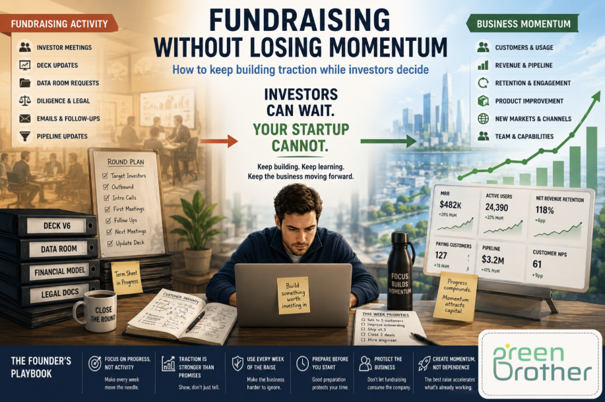
Investors can wait. Your startup cannot.
The best fundraising strategy is not to create the impression of momentum. It is to keep building enough real momentum that the investment case becomes stronger while investors are evaluating it.
Make every month of the raise produce new evidence. Then an investor who waits is not looking at the same company later. They are looking at a better one.
Prepared founders move faster.
This article was written based on Green Brother’s accelerator and investment experience. It is educational content, not legal or financial advice.
In our next blog post, we’ll talk about the Raise for the Next Proof Point.
Stay tuned!