
Author: Toufik Dallal
Why it matters now?
Most fundraising stories focus on the pitch. And for good reason: getting to a term sheet is genuinely hard. It takes months of relationship-building, refinement, and persistence. But across the EU and CEE ecosystem, a pattern plays out often enough that it deserves its own conversation. Founders clear the hardest part of fundraising, and then quietly lose the deal in the data room.
Not because the business is weak. Not because investors changed their minds. But because the data room revealed something the pitch did not: gaps, inconsistencies, or a level of disorganisation that made investors question whether this team was truly ready to deploy and manage capital responsibly.
This article is about that specific moment, and what to do before you get there.
The assumption most founders make
By the time a founder receives a data room request, the deal feels close. The investor is clearly interested. A term sheet is on the table or approaching. The data room feels administrative, a box-ticking exercise before the real work of closing begins. That assumption is understandable. It is also the assumption that costs founders the most.
How investors actually process a data room
The psychology of an investor during due diligence is almost the opposite of their psychology during a pitch. In the pitch meeting, they were looking for reasons to believe. In the data room, they are looking for reasons to stop. That shift is not cynicism. It is how responsible capital allocation works. And founders who do not understand it enter the process entirely unprepared for what is about to happen.
When an experienced investor opens a data room, they are not continuing the story you told them. They are stress-testing it. Every document they open is a question being answered, or left unanswered, or answered in a way that creates tension with something from the pitch. Their job, at this stage, is to find the gap between the narrative and the reality.
Disorganisation, in this context, is never neutral. A missing document, a folder that has not been updated, a financial model whose assumptions contradict the projections presented in the deck: none of these read as minor oversights. They read as signals about how the team operates, how they manage detail, and whether what they said in the pitch was actually accurate.
There is also a psychological dynamic specific to this stage that founders rarely consider: loss aversion compounds scrutiny. Investors who have spent significant time and political capital on a deal are simultaneously more committed to closing and more alert to mistakes. That combination makes them more sensitive to red flags, not less. Something that would have been overlooked in an early conversation can carry real weight when it appears in a legal document after a term sheet has been issued. The data room is not a presentation. It is a record. Records need to hold up under scrutiny, not just under enthusiasm.
The six things that quietly kill deals in the data room
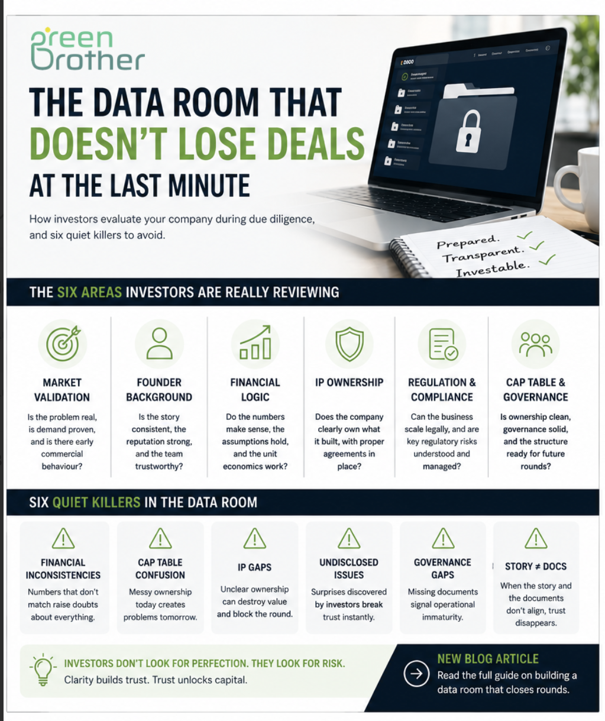
Most data room failures do not look dramatic. There is no single document that ends the conversation. Investor confidence erodes gradually, question by question, until the conviction that drove the term sheet simply is not there anymore. The patterns that cause this tend to cluster around the same six areas.
- 🔍 Financial inconsistencies
This is the most common and most damaging. Numbers in the data room that do not match the pitch. A revenue figure that differs between the deck and the management accounts. A burn rate that contradicts the runway calculation. Projections whose assumptions cannot be found anywhere in the model. When investors spot these things, which they do quickly, every number in the room becomes suspect. The cause is rarely dishonesty; it is usually version control or a model updated after the deck was locked. The effect is the same regardless.
- 🔍 Cap table and ownership problems
Cap table confusion stops deals more often than founders expect. Undisclosed shareholders, missing vesting schedules, advisory shares issued without proper documentation, convertible notes whose dilution implications were never clearly explained: these create serious friction. Investors need to understand exactly who owns what, what happens to that ownership at exit, and whether any claims could surface later. Ambiguity here is not a minor issue. It is a structural concern.
- ⚠️ IP ownership gaps
For technology companies, this is non-negotiable. Code written by a contractor who never signed an assignment agreement. A product built on open-source components whose licences are incompatible with commercial use. Early work done by a co-founder who left without formalising their exit. Investors need to know unambiguously that the company owns what it built. A verbal understanding is not sufficient at this stage, and “we think it is fine” is not an answer that closes rounds.
- ⚠️ Undisclosed legal matters
Disputes with former employees or co-founders, outstanding tax liabilities, a regulatory issue in a key market, a non-compete from a founder’s previous employer: any of these can surface during due diligence. The instinct is to stay quiet about them, especially if they feel minor or already handled. The right move is always to disclose them proactively, with a clear explanation of the current status. An investor who learns about a problem from your disclosure is still in the deal. An investor who discovers it themselves is usually not.
- 🔍 Governance and documentation gaps
Board minutes that do not exist. Shareholder agreements never formally executed. Employment contracts missing or inconsistent. A data protection policy that was copy-pasted and never implemented. Each of these, individually, might be explainable. Together, they suggest a company that has been running on good intentions rather than proper foundations. For an organisation about to take on institutional capital, that picture is a legitimate concern.
- ⚠️ The story and the documents do not match
This is the subtlest pattern and often the most damaging. Everything in the data room might be technically accurate, but the narrative it tells diverges from the pitch. A key customer described as a paying account turns out to be a pilot. A team member described as full-time has a part-time contract. The traction story shifts in ways that feel small but that investors notice immediately. An investor who feels misled, even on a minor point, will approach everything else in the room with a fundamentally different posture.
What quietly blocks deals at this stage
Beyond the document-level issues, there are subtler patterns that undermine late-stage due diligence even when the paperwork is largely in order.
Response time and completeness matter more than founders expect. How quickly a team responds to due diligence requests, and how thoroughly, tells investors a great deal about how they will operate as a portfolio company. Slow responses, partial answers, documents that need to be chased: all of these are read as operational signals. Investors are not just evaluating what you have built. They are evaluating what it will be like to work with you.
The quality of financial thinking is another area that separates strong data rooms from weak ones. Investors are not expecting precise projections. They are expecting coherent logic. Can the model assumptions be traced? Are the commercial drivers reasonable? Is there a clear connection between the activity described and the numbers produced? A model that appears to have been built to justify a valuation rather than to understand a business creates doubt about everything it claims.
And then there is founder tone. How a team responds to questions during due diligence shapes the relationship before it has even formally begun. Defensiveness, reluctance to engage with specific lines of questioning, or a pattern of minimal responses that require follow-up: these signal a difficult working relationship ahead. Investors who sense that a founder views due diligence as adversarial will often walk away from a deal that was otherwise close to closing.
What “good enough” actually looks like
Investors working with early-stage companies do not expect a fully institutionalised data room. They understand that processes are still being built, that some documentation is incomplete, and that governance is evolving. The bar is not perfection. It is honesty, clarity, and evidence that the team understands their situation accurately.
Good enough means a financial model whose assumptions are visible and internally consistent, even if the projections are uncertain. A cap table that any investor can understand in five minutes, with no surprises. IP that is clearly owned by the company, with documentation to support it. Employment contracts that reflect what investors were told. And a folder structure that makes the data room navigable without assistance.
Where weaknesses exist, the right approach is to surface them early with a clear account of the status and the plan. Proactive disclosure is almost always received better than mid-process discovery.
A data room readiness checklist
Before sharing access, sit honestly with these questions:
🔍 Do all financial figures in the data room align with what was presented in the pitch deck?
🔍 Is the cap table fully documented, including all convertibles, SAFEs, and advisory shares?
🔍 Do all founders and key contributors have IP assignment agreements in place?
🔍 Are there any legal disputes, regulatory issues, or outstanding liabilities that have not been disclosed?
🔍 Do employment contracts reflect the team descriptions given to investors?
⚠️ Is there anything in the data room that contradicts or significantly complicates the pitch narrative?
🔍 Can a new investor navigate the data room independently, without a guided tour?
If any of these give you pause, that hesitation is worth acting on before you share access, not after.
A final thought
Getting to a term sheet is a real achievement. It means investors believe in the opportunity and in the team behind it. The data room should honour that belief, not undermine it.
Investors enter due diligence looking for reasons to stop. The founders who close are the ones who have done the quiet, unglamorous work of giving them reasons to continue instead. Prepare the data room with the same seriousness you brought to the pitch, and the final mile becomes far shorter.
Fundraising does not fail in the pitch. Fix this early, and closing becomes something you can actually plan for.
This article was written based on Green Brothers’ accelerator and investment experience. It is educational content, not legal or financial advice.
In our next blog post, we”ll talk about the Valley of Death.
Stay tuned!
Important notice: This is educational content, not legal or financial advice.