
Author: Toufik Dallal
Why it matters now?
In early-stage startups, speed is everything. Teams are small, pressure is constant, and every decision feels like it carries real consequences. In that environment, it’s entirely natural for founders to stay close to everything: product, sales, hiring, operations. The instinct to be involved is healthy. It’s often what got the company this far. But this is exactly where a subtle risk takes hold.
What feels like diligence can quietly become control. And control, when it spreads too far, doesn’t protect the company. It slows it down. Micromanagement rarely announces itself as a problem. In the early days, it looks like care, like high standards, like a founder who gives a damn. But inside a growing company, it becomes something else entirely: a hidden blocker that compounds quietly until it’s very difficult to undo.
The assumption most founders make
“I’m not micromanaging. I just want things done properly.” “I can do this faster myself.” “We can’t afford mistakes right now.”
These thoughts are normal, and at the early stage, they’re understandable. But they obscure something important. Control feels efficient in the short term. The problem is that it creates dependency in the long term, and dependency doesn’t scale. What solves today’s problem plants the seed of tomorrow’s structural one.
What micromanagement actually is
Micromanagement isn’t the same as being involved. Founders should be involved. The distinction is more specific than that.
It’s taking back decisions that were already delegated. It’s rewriting someone’s work instead of guiding it. It’s quietly reducing a team member’s ownership on their tasks. It’s creating reliance where capability should be growing. The result is a team that shifts from thinking to waiting, and once that pattern sets in, it’s genuinely hard to reverse. People stop bringing their judgement because they’ve learned it won’t be used.
What investors actually observe
Investors rarely ask directly whether a founder micromanages. But they see the signals clearly. Does the team speak independently in meetings, or do they defer to the founder before answering? Are decisions distributed across the team, or do they all flow through one person? Is the founder a bottleneck? Can the company move forward without constant founder input?
These aren’t abstract observations. Micromanagement shows up as a scalability risk, and investors are explicitly looking for scalability risk. They don’t look for perfection. They look for risk. And a company where all roads lead back to one person is a company with a structural ceiling already built in.
The damage it causes, quietly
What makes micromanagement genuinely dangerous is that it rarely breaks things immediately. The damage accumulates below the surface.
Execution slows down because everything has to flow through one person. The team stops developing because they’re not given the room to grow. Accountability weakens because ownership was never truly handed over. The founder burns out because the entire operational load sits on their shoulders. And when due diligence arrives, investor confidence takes a hit, not because of the product, but because of how the company actually runs.
Fundraising doesn’t fail in the pitch room. It fails in the weeks after it, when the real structure of the company becomes visible.
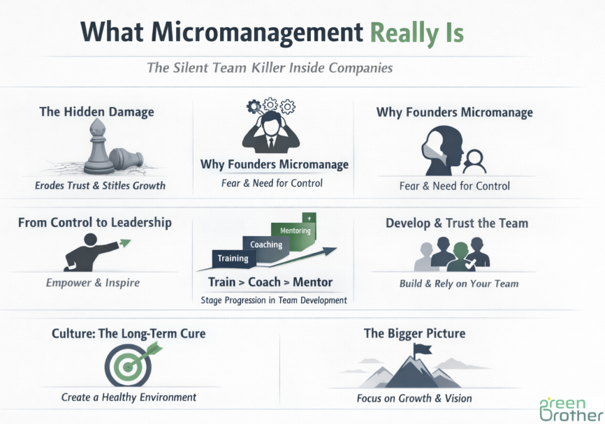
Why founders micromanage, even when they know better
This isn’t a story about bad leadership. It’s a story about understandable pressure meeting an absence of structures.
The drivers are familiar: a founder whose identity is deeply tied to the product, fear of failure at a fragile stage, a team that doesn’t yet have the experience to be fully trusted, no clear frameworks for who decides what, and sometimes a history of past mistakes that taught the wrong lesson about control. The intention behind all of this is usually good. The effect is limiting, regardless of intention.
The shift from control to leadership
Leadership begins at the point where control becomes a constraint. The shift itself is simple to describe, even if it’s difficult to practice.
It means moving from doing to defining how things should be done. From giving answers to asking better questions. From checking tasks to setting direction and then trusting the team to move within it. Control focuses on output. Leadership builds capability. The difference sounds subtle, but over time it’s the difference between a company that scales and one that stays small because one person can only hold so much.
The role of self-awareness
Micromanagement often operates on autopilot. It doesn’t feel like control from the inside because it’s driven by care, not by a desire to dominate. That’s what makes it hard to catch.
The signals to watch for: you frequently rewrite your team’s work before it goes out. You find yourself stepping into details without being asked. You struggle to fully let go of something you’ve delegated. You have a persistent feeling that things will fall apart without your direct involvement.
Self-awareness is the first leadership tool. Nothing changes without it.
Developing the team, then trusting the team
Trust isn’t a starting point. It’s built, deliberately, through a progression that most founders skip past too quickly.
In the early, training stage, your job is to be hands-on. You explain what good looks like, you set clear expectations, you’re present and directive. That’s appropriate.
As the team grows, the role shifts into coaching. You guide decisions rather than make them. You ask questions instead of giving answers. You allow controlled mistakes because mistakes are how capability develops.
Further along, in a mentoring relationship, you step back. You focus on thinking and direction rather than execution. You trust ownership fully because you’ve built it deliberately.
Micromanagement usually happens when founders stay in training mode long after the team is ready for more, or when they expect mentoring-level outcomes without having done the work to build the capability first. Strong leaders adjust their involvement based on the team’s actual stage, not based on their own anxiety.
Culture as the long-term cure
Micromanagement doesn’t stay as a behaviour. Left unaddressed, it becomes culture: a quiet organisational understanding that decisions don’t really belong to the people making them.
The long-term solution isn’t simply “let go more.” That’s too vague to act on. The real solution is building a system where control isn’t needed, because expectations are clear, ownership is defined, psychological safety exists, and decision-making principles are consistent and shared. Culture reduces the need for control. It’s the infrastructure that lets a company function without a founder in every room.
The bigger picture
Micromanagement isn’t just a team dynamic issue. It’s a scaling issue. When decisions are centralised in one person, growth slows. When people aren’t developed, bringing in more people doesn’t solve the problem. And when investors can see that the company depends structurally on its founder, they hesitate, not because of the product, but because of the architecture underneath it.
A self-check before your next round
Before a hiring push or a fundraising process, sit with these questions honestly:
Do decisions happen without you in the room? Does your team challenge you, or wait for your approval? Are you creating clarity, or rework? Are you developing people’s thinking, or replacing it? Do you adjust your leadership style based on where the team actually is?
If most of the answers point back to you, that’s the signal.
A final thought
Micromanagement doesn’t come from weakness. It comes from care, from pressure, from a deep sense of responsibility for something you’ve built. Those are good instincts. But left unchecked, they limit the very thing you’re trying to grow.
Early-stage doesn’t mean unprepared. Leadership isn’t about doing more. It’s about enabling more.
Clarity builds trust. Trust unlocks scale.
This article was written based on Green Brothers’ accelerator and investment experience. It is educational content, not legal or financial advice.
In our next blog post, we”ll talk about Data Room.
Stay tuned!
Important notice: This is educational content, not legal or financial advice.