
Author: Toufik Dallal
Why this matters now
In early-stage fundraising, founders naturally focus on the things they can point to: product progress, traction numbers, market size. Investors focus on those things too. But a surprising number of deals don’t stop because of the product. They stop because of the team, and not necessarily because the team is bad. Because the risk around the team is unclear, unmanaged, or simply too high.
This is the distinction that most founders miss: investors don’t invest in teams. They invest in teams they can trust to handle risk. Understanding what “team risk” actually means, and how it’s assessed, changes how you prepare.
The assumption most founders make
“Our team is strong. We’re committed. We work well together.”
That may be entirely true. But it isn’t what’s being evaluated. Founders tend to describe their teams in terms of motivation, shared vision, and personal chemistry. These things matter, but they aren’t what an investor is trying to understand. The question investors are actually asking is quieter and more unsettling: where can this team fail under pressure?
What investors are actually reviewing
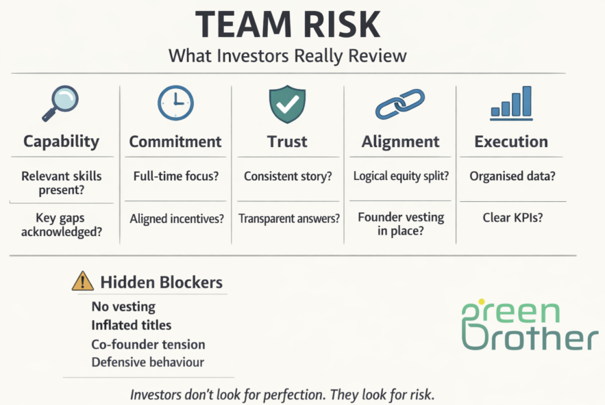
Team risk isn’t one thing. It’s a combination of signals, assessed across several dimensions.
Capability versus stage fit. The first question is whether the team matches where the company actually is right now. Can they build the product? Can they sell it? Can they begin to scale it? Risk shows up when there’s strong vision but weak execution, when a technical team has no commercial ability, or when founders haven’t evolved alongside the company. Nobody expects a perfect team at the early stage, but investors do expect a team that can reach the next milestone. That’s the minimum bar.
Founder dependency. Can the company keep moving without one specific person? Investors look for signs of distributed decision-making, genuine ownership across the team, and the ability to execute without constant founder involvement. When everything runs through a single founder, when there’s no real delegation, when the team waits rather than acts, that’s a significant hidden risk. It’s also one of the most common ones, and it connects directly to the question of whether this company can ever scale.
Alignment and incentives. Are all the founders and key team members actually aligned, not just in the pitch, but in practice? Investors assess vision alignment, role clarity, long-term commitment, and equity structure. Misalignment rarely surfaces in a pitch meeting. It surfaces later, in the messy moments, and experienced investors know this. Red flags include founders with quietly different expectations about the future, overlapping or unclear roles, equity that doesn’t reflect actual contribution, and early conflicts that were never properly resolved.
Execution consistency. Anyone can execute once. What investors want to see is the capacity to deliver repeatedly, across different conditions. Are deadlines met? Does the team learn from mistakes? Do they adjust based on feedback, or do they repeat the same patterns? Inconsistent progress, plans that change without clear reasoning, a team that reacts rather than decides, all of these create doubt. Consistency, even in small ways, builds trust.
Hiring judgment. Early hires define a company’s culture and trajectory for years. Investors pay attention to who you hire, how you hire, and when you choose to hire. Reactive hiring, filling roles with friends rather than with the right people, no clear criteria for what a good hire looks like, or bringing people on too early before the need is real, these signal future problems. The pattern matters as much as any individual decision.
Coachability and self-awareness. How does the team respond to input? This is one of the most closely observed signals, and one of the hardest to fake. Investors watch for genuine openness to feedback, the ability to reflect honestly, and a willingness to change course. Founders who become defensive when challenged, who quietly ignore feedback, or who consistently attribute problems to external factors rather than internal ones, set off alarms. Early-stage companies operate in a constant state of learning. A team that can’t learn is a team that can’t adapt.
The risks investors sense but rarely say out loud
Some of the most influential concerns in a due diligence process are never stated directly. They take the form of quiet conclusions: this team will struggle to scale, the company is too dependent on one person, the founders don’t seem aware of their own gaps, execution feels chaotic. These observations don’t always become explicit feedback. But they slow things down, and often they stop them entirely.
What “good enough” looks like
Investors understand early-stage reality. Nobody expects a complete, fully-formed team at the seed stage. What good enough actually looks like is clear roles and responsibilities, evidence of execution even if the wins are modest, honest awareness of where the gaps are, the demonstrated ability to learn and adjust, and early signs of delegation and real ownership spread across the team.
The standard isn’t perfection. It’s managed risk. When investors can see that a team understands its own vulnerabilities and is working with them rather than around them, trust follows.
The gap most founders miss
There’s a fundamental mismatch in how founders and investors approach the team conversation. Founders present strengths. Investors evaluate weaknesses. A founder says “we have a great team.” An investor hears that and thinks: where does this team break? These aren’t hostile questions. They’re the right questions. And bridging that gap, learning to anticipate and address it, is one of the most valuable things a founder can do before fundraising.
A checklist before you start
Before approaching investors, sit honestly with these questions:
Do we know our current team gaps clearly? Can the company operate without constant founder control? Are roles and responsibilities fully clear to everyone, not just on paper? Can we demonstrate consistent execution, even in small ways? Are we hiring based on genuine need, or convenience? Do we actively seek feedback and actually use it?
If you hesitate on any of these, investors will too.
The bigger picture
Team risk isn’t about judging people. It’s about predicting outcomes. A strong product inside a weak team structure will struggle. A good team with clear self-awareness adapts, improves, and finds a way. That’s why team risk sits at the centre of due diligence, even when it’s never explained in those terms.
A final thought
Team risk isn’t something to hide or work around. It’s something to understand, name clearly, and manage. The founders who earn trust aren’t the ones who look perfect. They’re the ones who are honest about where they are, realistic about the risks they carry, and prepared to address them directly.
Interest is easy to generate. Trust is harder. And trust, in the end, is built on how you handle risk.
This article was written based on Green Brothers’ accelerator and investment experience. It is educational content, not legal or financial advice.
In our next blog post, we”ll talk about what micromanagement really is.
Stay tuned!
Important notice: This is educational content, not legal or financial advice.