
Author: Toufik Dallal
Why it matters now?
Across Europe and especially in the CEE innovation ecosystem, we regularly meet founders with impressive technology. Strong engineering teams. Sophisticated prototypes. Years of research behind them. On paper, many of these startups look highly innovative.
Yet a surprising number never reach commercial scale.
The problem is rarely the technology itself. More often, the issue is that innovation has been developed in isolation from the realities of the market, the customer, or the business model. Founders optimise for technical readiness while assuming commercial readiness will come later.
Unfortunately, that “later” is exactly where many startups disappear.
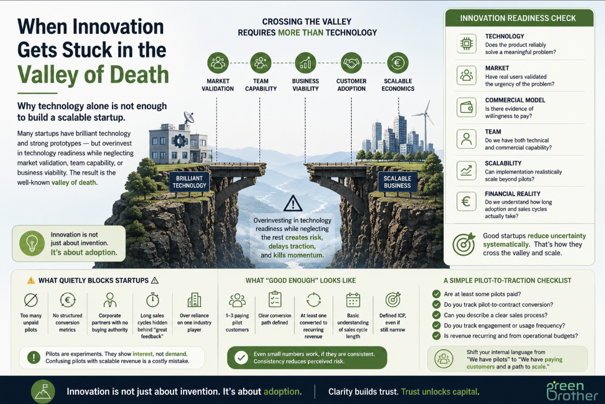
This gap between promising prototypes and scalable commercial products is often called the valley of death. It is where grants end, pilot enthusiasm fades, investors become more cautious, and startups suddenly realise that a working technology is not the same thing as a working company.
In accelerator programs, investment discussions, and corporate innovation projects, we see this pattern repeatedly. The startups that survive are rarely the ones with only the best technology. They are usually the teams that understand how technology, market timing, customer behaviour, and execution fit together.
Because innovation is not just about invention. It is about adoption.
The Common Founder Assumption
Many early-stage founders believe that if the technology is good enough, the market will eventually recognise its value. This assumption is understandable, especially in deep tech, mobility, energy, climate, or university-driven innovation environments where technical excellence is heavily rewarded early on. Grants, incubators, research partnerships, and pilot programs often focus primarily on Technology Readiness Level, or TRL progression.
But investors and customers evaluate innovation differently. A corporation does not buy technology because it is technically elegant. A city does not implement innovation because it won an award. Investors do not fund a startup simply because the prototype works.
They ask a more difficult question: Can this become a scalable, repeatable, commercially viable business?
That changes the conversation completely.
Why Technology Readiness Alone Creates Risk 🔍
Technology readiness matters. Of course it does. Especially in regulated sectors like energy, mobility, climate, medtech, or industrial innovation. Without technical credibility, there is nothing to commercialise. But overinvestment in technology readiness without parallel market validation creates imbalance.
We often see startups spend years refining features before properly testing whether customers are willing to pay, how procurement decisions are made, or whether integration into existing systems is realistic. By the time these questions appear, the startup has already consumed significant time and capital. From an investor perspective, this increases risk instead of reducing it.
Investors do not look for perfection. They look for risk.
A technically advanced product with unclear commercial adoption is often considered riskier than a simpler solution with proven market demand. This surprises many technical founders, particularly first-time teams coming from research or engineering backgrounds.
The uncomfortable reality is that technical progress and business progress are not the same thing.
The Valley of Death Is Usually a Commercial Problem ⚠️
The phrase “valley of death” is often presented as a funding gap. In practice, it is usually a validation gap. The startup has enough technical credibility to attract attention, but not enough commercial proof to justify scalable investment. This is where many innovation projects stall.
Corporates may run pilots but avoid procurement. Public funding may support research but not market expansion. Investors may express interest but hesitate to commit because too many assumptions remain unresolved. Fundraising doesn’t fail in the pitch, it fails after it.
Once conversations move into due diligence, investors start examining questions that technology alone cannot answer:
Who actually pays for this?
How long is the sales cycle?
Is implementation scalable?
Does the team understand the customer deeply enough?
Can the startup survive procurement delays?
Is there evidence of repeatable demand?
If these answers remain unclear, the startup enters a dangerous middle zone. Too advanced for grants. Too risky for scale investment. That is the valley of death.
Why Team Capability Matters More Than Many Founders Expect 🔍
Strong technology cannot compensate for weak execution capability.
One of the biggest differences between startups that cross the valley of death and those that do not is the team’s ability to operate outside purely technical environments. At early stage, founders often underestimate how much commercial translation matters. The ability to explain value simply. Navigate procurement. Build partnerships. Understand regulation. Manage pilots strategically. Structure fundraising properly. Recruit commercially minded people early enough.
Especially in Europe, many technically brilliant startups struggle because the founding team remains too research-oriented for too long. This does not mean every founder must become a sales expert overnight. But it does mean the company needs balanced capability early. Investors review this very carefully.
A startup with moderate technology and a highly adaptable team is often seen as more investable than a startup with exceptional technology but limited commercial understanding.
Prepared founders move faster.
Market Validation Is Not a Future Task
Another common issue is treating market validation as something that happens after product development. In reality, validation should happen continuously and in parallel. This includes understanding whether the problem is painful enough, whether budgets already exist, how decisions are made internally inside customer organisations, and what operational barriers might slow adoption. Especially in B2B innovation sectors, founders often mistake pilot interest for scalable demand. Interest is not proof.
A pilot can demonstrate curiosity. It does not automatically demonstrate willingness to pay, operational urgency, or repeatability. The strongest early-stage teams use pilots strategically. They are not just testing technology. They are testing procurement logic, pricing assumptions, integration friction, user behaviour, and conversion probability.
That distinction matters enormously.
What “Good Enough” Looks Like at Early Stage
Founders sometimes assume investors expect complete certainty before investing. They do not. Early-stage investors understand that uncertainty is part of innovation. What they want to see is evidence that the startup is reducing the right risks deliberately.
Good enough at early stage often looks like this:
A working product solving a clearly defined problem
Real customer engagement, even if still small
A focused market rather than an overly broad vision
Evidence that someone is willing to pay
A realistic understanding of sales and procurement cycles
A team capable of learning and adapting quickly
Clear ownership of IP and governance basics
Commercial thinking developing alongside technical progress
The startups that survive are rarely the ones with zero uncertainty. They are the ones reducing uncertainty systematically.
A Simple Innovation Readiness Check
Before scaling fundraising or expansion efforts, founders should ask themselves:
🔍 Technology
Does the product reliably solve a meaningful problem?
🔍 Market
Have real users validated the urgency of the problem?
🔍 Commercial Model
Is there evidence of willingness to pay?
🔍 Team
Do we have both technical and commercial capability?
🔍 Scalability
Can implementation realistically scale beyond pilots?
🔍 Financial Reality
Do we understand how long adoption and sales cycles actually take?
⚠️If multiple answers remain unclear, the startup may still be technically innovative, but commercially fragile. Early-stage doesn’t mean unprepared.
A final thught
Innovation ecosystems often celebrate invention. Markets reward execution. That difference explains why so many promising technologies struggle to cross the valley of death.
The startups that succeed are usually not the ones obsessed only with technology readiness. They are the ones building commercial readiness at the same time. They understand that innovation is not just about creating something impressive. It is about creating something adoptable, scalable, and economically valuable.
Clarity builds trust. Trust unlocks capital.
This article was written based on Green Brother’s accelerator and investment experience. It is educational content, not legal or financial advice.
In our next blog post, we’ll talk about Fundraising Without Losing Momentum.
Stay tuned!